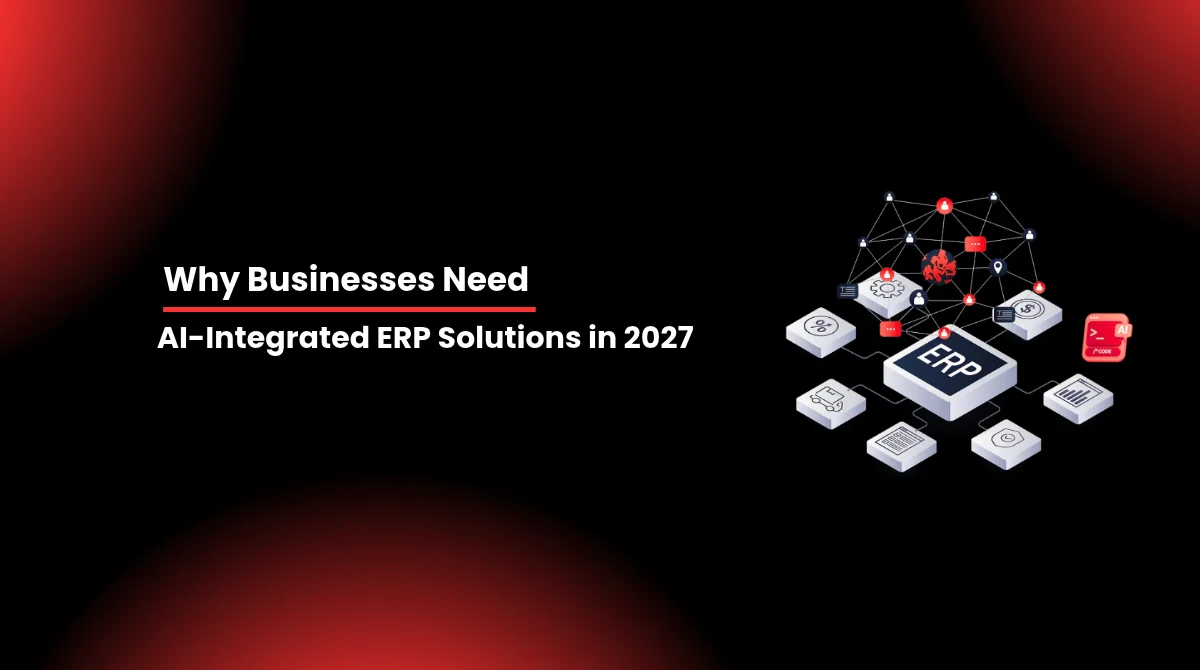
Businesses in 2027 need more than traditional software to manage their daily operations. As companies handle increasing amounts of customer information, financial transactions, inventory, employee activities, and business data, managing everything through disconnected systems becomes challenging. This is where AI-integrated Enterprise Resource Planning (ERP) solutions make a significant difference.
An AI-powered ERP system combines artificial intelligence, machine learning, predictive analytics, and business process automation to help organizations manage their operations more efficiently. Unlike traditional ERP software, which primarily records and organizes information, AI-integrated ERP solutions can analyze business data, identify patterns, generate predictions, and support smarter decisions.
Whether you operate a startup, manufacturing company, retail business, or service-based organization, investing in an intelligent ERP system can improve productivity, reduce operational costs, and support long-term business growth.
What Are AI-Integrated ERP Solutions?
AI-integrated ERP solutions are advanced business management systems that combine traditional ERP functionalities with artificial intelligence technologies. These systems connect important business departments, including accounting, inventory, human resources, sales, purchasing, and customer relationship management, within a centralized platform.
Traditional ERP systems require employees to analyze reports and make decisions manually. AI-powered ERP software takes this process further by identifying trends, predicting future requirements, and automating repetitive activities.
For example, an AI-enabled ERP system can predict inventory shortages, identify unusual financial transactions, recommend purchasing schedules, and analyze customer demand. This allows business owners and management teams to make informed decisions using real-time business insights.
Why Do Businesses Need AI-Integrated ERP Solutions in 2027?
The business environment is becoming increasingly competitive, and companies must find smarter ways to manage their resources. AI-integrated ERP systems offer several advantages that help businesses improve operational efficiency and maintain a competitive position.
1. Automating Repetitive Business Operations
Manual business processes consume valuable time and increase the possibility of human errors. Tasks such as invoice generation, purchase order management, payroll processing, inventory updates, and report preparation can become difficult when businesses grow.
AI-powered ERP systems automate these repetitive activities and allow employees to focus on more important responsibilities.
For example, a service-based company can use an integrated ERP platform to manage customer bookings, employee schedules, service assignments, and invoice generation. This creates a smoother workflow while reducing administrative workloads.
2. Making Better Decisions With Predictive Analytics
Business decisions based on outdated information can create unnecessary expenses and operational challenges. AI-integrated ERP software uses historical and real-time data to identify patterns and predict potential business outcomes.
Predictive analytics can help businesses:
- Forecast product demand and inventory requirements.
- Identify changing customer purchasing patterns.
- Estimate future revenue and expenses.
- Recognize potential supply chain disruptions.
- Improve financial planning and resource allocation.
These insights allow management teams to respond to changing business conditions before problems become serious.
3. Improving Inventory and Supply Chain Management
Inventory management is one of the most important responsibilities for manufacturing, retail, wholesale, and distribution businesses. Overstocking increases storage expenses, while insufficient inventory can result in delayed orders and dissatisfied customers.
AI-powered ERP systems analyze sales history, seasonal demand, supplier performance, and purchasing trends to recommend appropriate inventory levels.
Machine learning algorithms can also identify unusual inventory movements and highlight potential supply chain issues. This helps businesses maintain better stock availability while controlling operational costs.
4. Enhancing Financial Management and Reporting
Financial management becomes more complicated as businesses expand. Managing expenses, invoices, payments, budgets, and financial reports through separate platforms can create inconsistencies.
An AI-integrated ERP system connects financial information across departments and automates several accounting activities.
Some important capabilities include:
- Automated invoice processing and payment tracking.
- Expense categorization and financial reporting.
- Cash flow forecasting.
- Unusual transaction detection.
- Budget planning and financial analysis.
These features provide better financial visibility and help business owners understand their organization’s financial performance.
5. Improving Customer Experience and Business Operations
Customer expectations continue to increase, making efficient service delivery essential for business success. AI-integrated ERP solutions help companies connect customer information with sales, inventory, scheduling, billing, and service management.
Consider a service-based business such as Gocinico. Its website highlights automated calendar scheduling, invoice generation, online payments, and additional services such as laundry and handyman support. An integrated ERP platform could bring these operational activities together, providing centralized visibility into bookings, employees, invoices, and service requests.
This type of automation helps businesses coordinate activities more effectively and deliver consistent customer experiences.
What Are the General Statistics Behind AI Adoption and Business Automation?
Artificial intelligence is becoming an important part of business technology strategies. Industry research also highlights why organizations are exploring AI adoption and intelligent automation.
| General business technology indicator | Reported finding |
| Global AI adoption | 78% of organizations reported using AI in at least one business function in 2024 (McKinsey) |
| Generative AI adoption | 71% of organizations reported regularly using generative AI in at least one business function in 2024 (McKinsey) |
| AI investment | 92% of companies planned to increase their AI investments over the following three years (McKinsey, 2025) |
These figures demonstrate growing interest in artificial intelligence across industries. However, adopting AI successfully requires appropriate infrastructure, reliable business data, and well-planned software integration.
Which Industries Benefit Most From AI-Powered ERP Software?
AI-integrated ERP solutions can support businesses across different industries by improving information management and automating important processes.
Manufacturing and Production
Manufacturing companies can use AI-powered ERP systems to monitor production activities, forecast material requirements, optimize inventory, and identify equipment maintenance requirements.
Retail and E-commerce
Retail businesses can benefit from automated inventory management, customer demand forecasting, sales analysis, order processing, and supplier coordination.
Healthcare and Medical Services
Healthcare organizations can use ERP platforms to manage procurement, billing, employee scheduling, financial operations, and administrative workflows.
Logistics and Distribution
AI-integrated ERP systems help logistics companies monitor shipments, optimize resource allocation, analyze delivery performance, and improve supply chain visibility.
Service-Based Businesses
Cleaning companies, consulting firms, maintenance providers, and other service businesses can manage bookings, employee assignments, customer information, invoices, and payments through centralized software.
How to Choose the Right AI ERP Development Company?
Selecting the right technology partner is essential when implementing an AI-powered ERP system. Every business has different operational requirements, so choosing a ready-made solution may not always provide the flexibility needed for long-term growth.
A reliable software company should understand your business processes, identify automation opportunities, and develop solutions that align with your objectives.
Consider the following factors before selecting an ERP development partner:
- Industry experience: Choose developers who understand your business requirements and industry-specific workflows.
- AI development expertise: Look for AI developers with experience in machine learning, predictive analytics, automation, and AI integration.
- Customization capabilities: Ensure the company can develop ERP modules according to your operational requirements.
- Integration expertise: Your ERP platform should connect with existing CRM systems, accounting software, payment gateways, and third-party applications.
- Data security: Check whether the development team follows appropriate data protection, access control, and security practices.
- Ongoing support: ERP software requires regular maintenance, performance improvements, and technical updates.
Working with experienced developers helps businesses avoid unnecessary complexity and build scalable software solutions.
Why Work With GoCinico for AI and ERP Software Development?
Choosing an experienced technology partner can make the ERP development process more organized and effective. GoCinico is a software company offering digital development services, including Laravel development, WordPress development, Shopify development, Wix development, and custom CRM solutions.
Businesses exploring AI-powered ERP systems can consider a development partner like GoCinico to discuss their software requirements, integration possibilities, and customized business applications.
An experienced development team can help identify opportunities for workflow automation, centralized data management, and intelligent business applications. If your organization is planning to hire AI developers, evaluate their technical expertise, experience with AI integration, and ability to understand complex business processes.
GoCinico’s development experience and focus on custom digital solutions make it a relevant example of the type of technology partner businesses can approach when planning their next software project.
What Is the Future of AI-Integrated ERP Solutions?
The future of ERP software will increasingly involve intelligent automation, conversational AI, predictive analytics, and connected business applications.
Businesses can expect ERP platforms to become more proactive rather than simply recording transactions. AI assistants may help employees retrieve business information, generate reports, identify operational issues, and recommend actions using natural-language commands.
However, successful implementation will depend on data quality, cybersecurity, employee training, and responsible AI usage. Businesses should approach ERP modernization with a clear implementation strategy rather than adopting artificial intelligence without defined objectives.
Conclusion
AI-integrated ERP solutions are becoming an important investment for businesses looking to improve operational efficiency, automate repetitive tasks, and make data-driven decisions in 2027. From inventory forecasting and financial reporting to customer management and employee scheduling, intelligent ERP software provides businesses with better control over their operations.
Choosing the right software company and experienced developers is equally important for successful implementation. Businesses planning to modernize their operations should evaluate their existing workflows, identify automation opportunities, and explore customized ERP solutions that support future growth.
With the right technology strategy and AI development expertise, organizations can transform traditional business management into a smarter, more connected, and efficient operational environment.
FAQ
AI-integrated ERP solutions are business management systems that combine artificial intelligence with traditional ERP functionalities. They use machine learning, predictive analytics, and automation to streamline operations such as inventory management, accounting, sales, and human resource management.
Businesses need AI-powered ERP software to automate repetitive tasks, improve operational efficiency, reduce manual errors, and make data-driven decisions. These solutions also help organizations manage growing business requirements and remain competitive.
The main benefits include automated workflows, predictive analytics, improved inventory management, accurate financial reporting, better resource allocation, enhanced customer experiences, and centralized business data management.
AI improves traditional ERP systems by analyzing business data, identifying patterns, predicting future requirements, and automating routine activities. It helps businesses move beyond basic data management toward intelligent and proactive decision-making.
Manufacturing, healthcare, retail, e-commerce, logistics, agriculture, construction, and service-based businesses can benefit from AI-powered ERP development. These systems can be customized to address specific industry workflows and operational challenges.
The cost depends on business requirements, software complexity, AI features, integrations, security requirements, and development time. A basic ERP solution generally costs less than a customized enterprise platform with advanced machine learning and predictive analytics capabilities.
Businesses should hire experienced AI developers because integrating artificial intelligence into ERP software requires expertise in machine learning, data analytics, API integration, software architecture, and cybersecurity. Skilled developers can create scalable solutions that align with business requirements.
GoCinico is a software company offering digital development services, including Laravel, WordPress, Shopify, Wix, and custom CRM solutions. Businesses can explore its development services when planning customized software applications, business automation, and technology integration projects.
